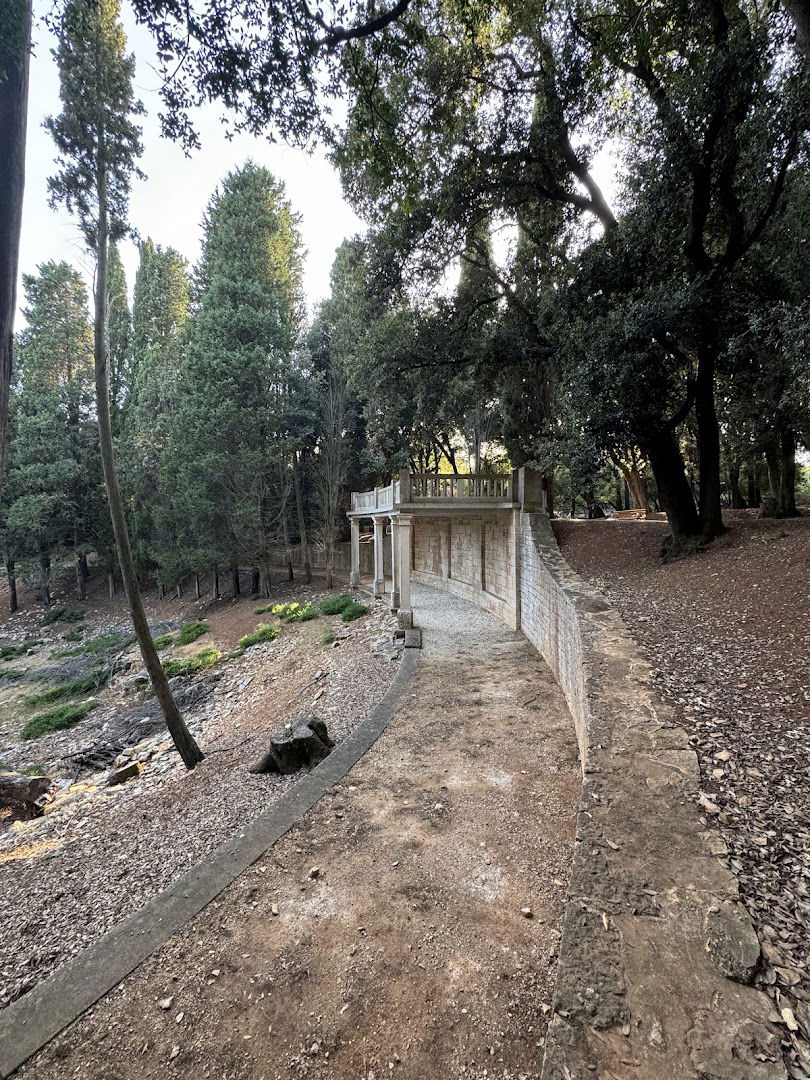
Paul Kupelwieser's Resting Place, NP Brijuni
Paul Kupelwieser's Resting Place
Discover the Architectural Heritage of Brijuni National Park
Brijuni National Park, renowned for its stunning landscapes and rich history, boasts an array of architectural marvels that highlight its diverse cultural heritage. From ancient buildings to modern adaptations, the park showcases layers of history that date back to different eras, particularly during the Venetian and Austro-Hungarian periods.
The Venetian Influence
During the Venetian era, Brijuni saw the construction of significant structures including a castle, churches, and fortifications designed to protect against pirate attacks. The most notable of these is the three-storey Venetian tower, crafted from robust stones and equipped with loopholes for defense. This tower served as a central administrative hub and residential area for Venetian governors and has a history dating back to the 12th century.
Medieval Churches
The island's architectural heritage is further enriched by several medieval churches. The largest, St. German's Church, features striking Gothic elements and was reputedly built in 1481. Nearby, the votive St. Rochus Church was constructed as a protection against plague epidemics in 1504, while the cemetery church of St. Anthony offers a glimpse into the burial practices of the time.
Villa Pava and the Boat House
Among the preserved traditional buildings is Villa Pava, a two-storey structure dating back to the 16th-18th centuries, reflecting the island’s agrarian past. The Boat House stands out as a testament to 20th-century architectural ingenuity. Built in 1901, it was designed by Eduard Kramer in the Art Nouveau style and now serves as an interpretation center for visitors, featuring interactive exhibits on the park's history and ecology.
Austro-Hungarian Fortifications
With the establishment of a naval port in Pula, Brijuni became strategically significant, leading to the construction of several fortifications. These include Fort Tegetthoff and the Monte Peneda battery, which house some of the well-preserved military equipment, including Škoda cannons. These fortifications offer insight into the military history of the region and its defenses during significant historical conflicts.
Preservation and Recognition
The Brijuni archipelago, reflecting its eclectic architectural styles, remains a vital link to understanding the island's historical context. It is designated as a national park, ensuring the protection and conservation of its unique heritage and natural surroundings. Each structure tells a story—whether through the remnants of fortifications or the serene beauty of its churches—making Brijuni a living museum.
Plan Your Visit
Whether you are an architecture enthusiast, a history buff, or just looking to explore the natural beauty of Brijuni, the national park offers a unique opportunity to experience the harmonious blend of nature and culture. Discover Brijuni's architectural gems and immerse yourself in the stories they tell.
- ponedeljek Odprto 24 ur
- torek Odprto 24 ur
- sreda Odprto 24 ur
- četrtek Odprto 24 ur
- Petek Odprto 24 ur
- sobota Odprto 24 ur
- nedelja Odprto 24 ur
 Google
Google
Google
Awesome place that should be visited when being here, especially to honor what the family Kupelwieser did to make this place in parts what it is today.
Google
Visitare il mausoleo di Paul Kupelwieser sull’isola di Brioni è un momento di riflessione e rispetto verso un uomo che ha profondamente creduto nella bellezza di questo luogo. Industriale austriaco e visionario, Kupelwieser trasformò Brioni da zona malarica a oasi naturale e culturale, investendo tempo, denaro e passione. Collaborò con personaggi illustri come Robert Koch per risanare l’isola e la rese un punto d’incontro per intellettuali e nobiltà europea. Fermarsi al suo mausoleo significa rendere omaggio a chi ha saputo vedere il potenziale nascosto di Brioni e ha fatto di tutto per farlo conoscere al mondo.
Google
A bit off the main path, seems a bit odd coming here but there is a gravel path coming the through the main way to this stone structure. Paul Kupelwieser clearly wanted this to be his final resting place; he built a mausoleum as the last abode for him and his wife. Unfortunately, he died in Vienna in 1919 and was buried there.
Podobne storitve